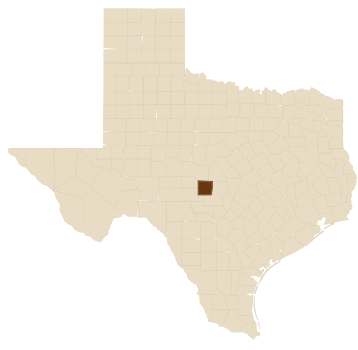
On July 6, 1851, Lt. Col. William J. Hardee chose a hill near Comanche Creek in what was then northern Gillespie County as the site for a new army post.3 For the next ten years Fort Mason was one of the links in a chain of forts meant to open the Texas frontier, and twenty of the officers who served there went on to become generals in the Civil War.3 When the soldiers left for good, the settlers took the fort apart stone by stone and built their town with it.2,3
Before the fort
For centuries the country along the Llano River was a summer hunting ground for roving Indian peoples, chiefly the Lipan Apaches, until Comanches moved down from the Panhandle in the eighteenth century and drove the Apaches south.1 Spain made some grants along the Llano in the late 1700s, but no permanent settlement came of them.1 In the mid-1840s German colonists from Fredericksburg and New Braunfels began moving in, risking the wilderness for a chance at larger tracts of land.1 William S. Gamel is thought to have arrived around 1846.2 Near the site of Mason is Gamel Spring, where John O. Meusebach is thought to have signed a treaty with the Comanche chief Ketemoczy in 1847.2
Twenty generals
In 1848 the War Department authorized a line of forts from the Rio Grande to the Red River.3 Hardee, assisted by Richard Austin Howard, picked the site on Post Oak Hill, and Bvt. Maj. Hamilton W. Merrill and two companies of the Second Dragoons established the post.3 It was probably named for Lt. George T. Mason, killed at Brownsville in the Mexican War, or for Gen. Richard Barnes Mason.3
The fort reached its largest garrison in January 1856, when the headquarters and six companies of the Second Cavalry were stationed there under Col. Albert Sidney Johnston.3 Twenty officers who served at Fort Mason before the Civil War became generals, twelve for the Confederacy and eight for the Union. Among them were Robert E. Lee, George H. Thomas, John Bell Hood, Earl Van Dorn, Fitzhugh Lee, E. Kirby Smith, William J. Hardee and Philip St. George Cooke.3 Settlers at first stayed close to the post, then spread out as raids grew fewer.3
A Union county
On January 22, 1858, the legislature established Mason County, named for the fort, and George W. Todd organized it on August 2.1 The law required the county seat to be within two miles of the fort, and on May 20, 1861, voters chose the town of Mason.1 The town had grown up around a sutler’s store and a blacksmith shop moved down from Post Hill.2 James E. Ranck opened a store around 1860 and became known as the “father of Mason” for his efforts to build the town.2
In February 1861 the county voted 75 to 2 against secession.1 Many of its settlers were German immigrants, mostly against slavery, who did not want to leave a country they had only recently joined or be drawn into another war. The 1860 census counted eighteen enslaved people in a population of 630.1 In March 1861 the fort was surrendered to the Confederacy, but it stood almost unmanned through the war, and Indian raids were especially severe.1,2 In 1862 Confederates held 215 prisoners at the fort, mostly civilians accused of Union sympathies, and marched them to Austin that August.3
The stones of the fort
Federal troops of the Fourth Cavalry reoccupied the fort on December 24, 1866, and the government built the county’s first telegraph line through Mason to the western forts.2,3 The fort was closed on March 23, 1869, and used one last time by state frontier forces in 1870 and 1871.3 After it was abandoned, nearby residents carried off equipment and building materials until almost every trace was gone, and many early homes in Mason contained stone from the fort.2,3
The first courthouse and jail were built in 1869. Before that, court was held under an old live oak near the town well on the northeast corner of the square.2 By 1890 nearly all of Mason’s buildings were stone.2 After the war beef was so cheap that cattle were killed for their hides, and Ranck’s store became a center of the hide trade. By the 1870s Mason was the hub of a thriving ranch country.2 Many of the big drives north started in Mason County.1
The Hoodoo War
Cattle theft brought on the Mason County War, commonly called the Hoodoo War, a feud that came to be seen as German against American-born settler.4 On February 18, 1875, a mob of about forty men took five accused cattle thieves from the jail and hanged them near Hick Springs.4 On May 13 Tim Williamson, charged with cattle theft, was killed by twelve men with blackened faces while a deputy was bringing him to Mason.4 Scott Cooley, a former Ranger and Williamson’s friend, swore revenge, and his retaliation took the lives of at least a dozen men.4
Maj. John B. Jones came with Texas Rangers to quiet the county, but he found little cooperation and discovered that some of his own men were Cooley’s old comrades.4 No trial in Mason County ever convicted any man of either faction for any of the murders.4 On January 21, 1877, the courthouse burned with all of the county’s records, including those of the feud.1,2
Herefords and stone
In 1882 or 1883 W. E. Wheeler is thought to have brought the first Hereford cattle into the county, and Mason County became well known for its Herefords.1 Manganese, iron and other minerals drew prospectors in the 1880s and 1890s, but with no railroad and too little ore the hoped-for industry never came.1 In 1890 a movement to carve a new Mineral County out of Mason and its neighbors was blocked by a petition from Mason County citizens.1
Fort Mason today
In 1975 a group of citizens began rebuilding one of the officers’ quarters on the old fort site, and the building now belongs to the Mason County Historical Society.3 Below the hill lies the town that was built, in part, from the fort’s stones.2,3
Through the years
- July 6, 1851Lt. Col. William J. Hardee chooses the site of Fort Mason.3
- January 1856Col. Albert Sidney Johnston commands the Second Cavalry at Fort Mason.3
- January 22, 1858The legislature establishes Mason County.1
- February 1861Mason County votes 75 to 2 against secession.1
- May 20, 1861Voters choose the town of Mason as county seat.1,2
- 1866–69Federal troops reoccupy Fort Mason, then close it.3
- 1869The first courthouse and jail are built.1,2
- 1875–77The Mason County War, or Hoodoo War.1,4
- January 21, 1877The courthouse and all county records burn.2
- 1882 or 1883W. E. Wheeler is thought to bring the first Herefords into the county.1
- 1975Citizens begin reconstructing one of the fort’s officers’ quarters.3
Sources
- 1. Alice J. Rhoades, “Mason County,” Handbook of Texas Online, Texas State Historical Association. www.tshaonline.org
- 2. Alice J. Rhoades, “Mason, TX,” Handbook of Texas Online, Texas State Historical Association. www.tshaonline.org
- 3. Julius E. DeVos, “Fort Mason,” Handbook of Texas Online, Texas State Historical Association. www.tshaonline.org
- 4. Margaret Bierschwale, “Mason County War,” Handbook of Texas Online, Texas State Historical Association. www.tshaonline.org
- 5. Newberry Library, Atlas of Historical County Boundaries: Texas individual county chronologies. publications.newberry.org
Explore further
- Read the full Handbook of Texas entry for Mason County
- Browse Mason County newspapers, maps and photographs on the Portal to Texas History
- Search historical markers in the Texas Historical Commission Atlas
- Read the Kimble County history in this series, including the 1895 survey of the Mason–Kimble line and what the surveyors said they could not find
Historical information only. Garrett Surveying, LLC is a land surveying firm, not a law firm, and nothing here is legal advice.