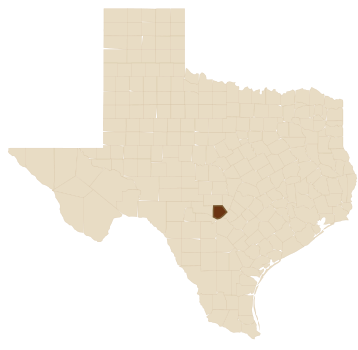
In 1847 the engineer who had surveyed New Braunfels left it behind and built a house in a quiet valley on Sister Creek.5 Within two years Nicolaus Zink had neighbors who had fled Europe after the failed revolution of 1848.5 Kendall County grew from settlements like his: small, German, independent-minded, and willing to suffer for their convictions.
The Latin Settlement
People had hunted and gathered in this country for as long as 10,000 years. Lipan Apaches, Kiowas and Comanches were the dominant peoples when the Germans began arriving in the 1840s.1 The Meusebach-Comanche Treaty of 1847 was meant to let settlers and Indians move through each other’s territory in peace, though raids on farms continued into the mid-1870s.1
Zink founded Sisterdale in 1847.5 Over the next two years he was joined by Forty-Eighters, exiles of the 1848 revolutions, and Sisterdale became one of the famous “Latin Settlements.”5 Their leader was Ernst Kapp, and the circle included Ottomar von Behr, Adolph Douai, August Siemering, Julius Dresel, Julius Froebel, Gustav Theissen and the Baron von Westphal, a brother-in-law of Karl Marx.5 Frederick Law Olmsted, John R. Bartlett and Duke Paul of Württemberg all visited and wrote about the place.5 Sisterdale became one of the centers of German abolitionism and Unionism before and during the Civil War.5
Tusculum and Comfort
In 1849 a group of German colonists from Bettina camped on the north side of Cibolo Creek and called their community Tusculum, after Cicero’s home in ancient Rome.2 In 1852 Gustav Theissen and John James laid out a townsite and renamed it Boerne, for the German author Ludwig Boerne.2 It had only ten houses in 1859.2
To the west, Germans from New Braunfels settled along Cypress Creek above its meeting with the Guadalupe in 1852, and in 1854 Ernst Hermann Altgelt laid out the town of Comfort near the site of an Indian village.4 Its settlers were Freemasons, freethinkers, political activists and liberals from Bettina and Sisterdale. They organized their town along cooperative lines and steadfastly opposed formal local government.4 Comfort opened a school soon after its founding, but no church was built there until 1892.4 Many of the early Germans in the area were freethinkers, and when a Catholic priest was assigned to Boerne in 1860, local sentiment led him to build his church on a hill outside town.1
A county of its own
At first this was part of Bexar County, and after 1856 part of Kerr County. Comfort competed with Kerrville to be Kerr’s seat, and Kerrville won.1,4 In 1859 residents of Boerne and Sisterdale petitioned for a new county. The legislature granted the petition in 1862, carving the county from Kerr and Blanco counties, and Boerne won the vote for county seat by sixty-seven votes.1,2
The county was named for George Wilkins Kendall, a New Hampshire printer who co-founded the New Orleans Picayune in 1837.3 He joined the Texan Santa Fe expedition in 1841, was marched to Mexico City as a prisoner, and turned the ordeal into a 900-page book that sold 40,000 copies in eight years.3 Riding with Ben McCulloch’s rangers in the Mexican War, he was hailed as the nation’s first war correspondent.3
The father of Texas sheep
In 1852 Kendall and three friends placed twenty-four Spanish merino rams and a flock of chaurro ewes on a ranch on the Nueces, with Joe Tait, an experienced herder from Scotland, as manager.3 Kendall soon moved the flock to Waco Springs near New Braunfels and took up the Post Oak Springs pasture near Boerne. He fought blizzards, grass fires and disease until 1856, when the flock began to make money.3 In the Picayune and the Texas Almanac he praised the Hill Country as sheep range. When scab became an epidemic in 1864, he was the first to build large vats and dip his flock of 5,000.3 At his death in 1867 he was generally regarded as the father of the sheep business in Texas.3 By 1880 sheep ranching was the county’s principal industry, and the county’s 16,259 sheep produced more than 65,200 pounds of wool.1
True to the Union
In 1861 Kerr County approved secession by 76 to 57, but the precinct that became Kendall County voted against it, 53 to 34.1 On August 10, 1862, a party of Hill Country Unionists bound for Mexico, mostly German intellectuals led by Maj. Fritz Tegener, was camped on the west bank of the Nueces River in present Kinney County when ninety-four mounted Confederates attacked an hour before sunrise.6 Nineteen Unionists were killed and nine were wounded; the wounded were executed a few hours after the battle.6 Comfort lost many young men.4 Confederates regarded the fight as an action against insurrectionists, while many Hill Country Germans saw it as a massacre.6
After the war the remains of the Unionists were gathered and buried at Comfort. The Treue der Union monument was dedicated there on August 10, 1866.1,6 It is the only German-language monument to the Union in the South where the remains of those killed in battle are buried, and a thirty-six-star flag of 1866 flies there at half-staff.6
Rails, resorts and Angora goats
Boerne built its courthouse in 1870, and the building was still in use in the 1990s, making it then the second-oldest courthouse in the state.2 The town gained a reputation for healthful air and quickly became a health resort; by 1884 it had five hotels.2 The San Antonio and Aransas Pass Railway reached Boerne in 1887, and in 1914 a line from Fredericksburg joined it just east of Comfort, giving rise to Welfare, Waring and Bankersmith.1 In the 1940s and 1950s, when the Hill Country was an international wool and mohair center, Adolf Stieler of Comfort reigned as “Angora Goat King of the World.”4
The old townsites
Much of Comfort’s original townsite is on the National Register of Historic Places, with half-timbered and Victorian buildings that survived a disastrous flood in 1978.4 Boerne’s Schuetzen Verein, formed in 1864, and its Village Band, formed around 1860, were still active in 1990.2 After the war Sisterdale settled into life as a quiet Hill Country hamlet of farmers, and in 2000 it counted sixty-three people.5 The valley where Zink and the Forty-Eighters once farmed is quiet again.
Through the years
- 1847Nicolaus Zink founds Sisterdale on Sister Creek.1,5
- 1849German colonists from Bettina found Tusculum on Cibolo Creek.2
- 1852Gustav Theissen and John James lay out Boerne.2
- 1854Ernst Hermann Altgelt lays out Comfort.4
- 1859Boerne and Sisterdale residents petition for a new county.1
- 1862The legislature creates Kendall County; Boerne becomes the seat.1,2
- August 10, 1862Hill Country Unionists are attacked on the Nueces River.6
- August 10, 1866The Treue der Union monument is dedicated at Comfort.6
- 1870Boerne builds the courthouse still in use in the 1990s.2
- 1887The San Antonio and Aransas Pass Railway reaches Boerne.1,2
- 1909Boerne votes to incorporate.2
Sources
- 1. Vivian Elizabeth Smyrl, “Kendall County,” Handbook of Texas Online, Texas State Historical Association. www.tshaonline.org
- 2. Vivian Elizabeth Smyrl, “Boerne, TX,” Handbook of Texas Online, Texas State Historical Association. www.tshaonline.org
- 3. Thomas W. Cutrer, “Kendall, George Wilkins,” Handbook of Texas Online, Texas State Historical Association. www.tshaonline.org
- 4. Glen E. Lich, “Comfort, TX,” Handbook of Texas Online, Texas State Historical Association. www.tshaonline.org
- 5. Glen E. Lich, “Sisterdale, TX,” Handbook of Texas Online, Texas State Historical Association. www.tshaonline.org
- 6. Anonymous, “Nueces, Battle of the,” Handbook of Texas Online, Texas State Historical Association. www.tshaonline.org
- 7. Newberry Library, Atlas of Historical County Boundaries: Texas individual county chronologies. publications.newberry.org
Explore further
- Read the full Handbook of Texas entry for Kendall County
- Browse Kendall County newspapers, maps and photographs on the Portal to Texas History
- Search historical markers in the Texas Historical Commission Atlas
- Read the Kerr County history in this series, including the 1886, 1894 and 1896 work on the Kerr–Kendall corner at Gillespie’s south line
- Read the Bandera County history in this series, whose 1856 act calls for Kerr’s corner at the west line of the Gayton Survey No. 408
- Read the Bexar County history in this series, whose 1879 boundary description ties to Kendall’s corner on Balcones Creek at the same Gayton survey
Historical information only. Garrett Surveying, LLC is a land surveying firm, not a law firm, and nothing here is legal advice.